
 \n
\n \n\n
AI Adoption Hits 53% Globally in 2026: What It Means
\n
Many assumed AI would be a gradual shift, but the data shows half the world’s population is already using it. This isn’t just an upgrade; it’s an unprecedented sprint.
\n \n
\n\n
 \n
\n\n\n
The Unprecedented Pace: How Did AI Adoption Hit 53% Globally by 2026?
\n
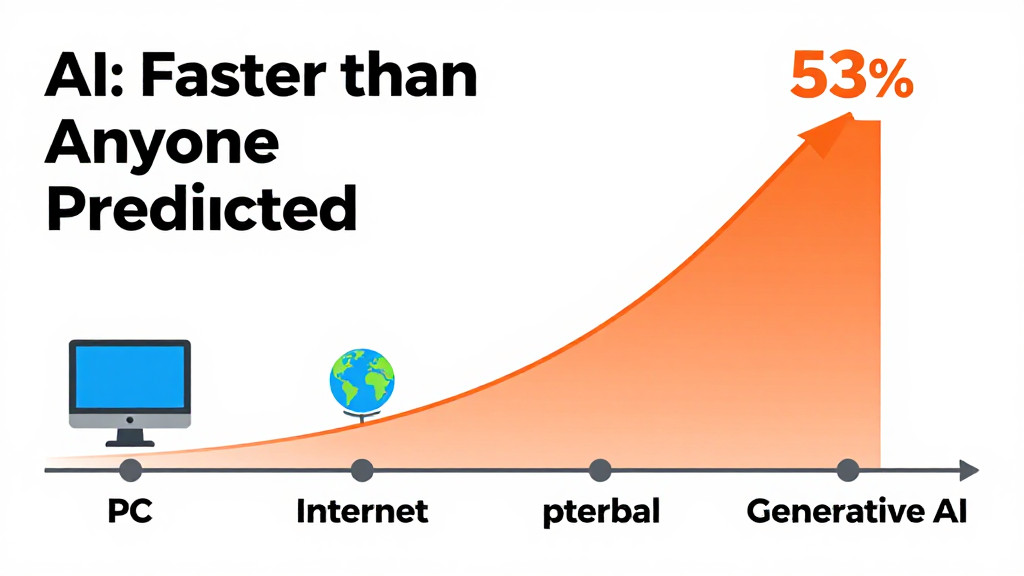
Direct answer: Generative AI’s rapid diffusion, driven by ease of use and immediate utility, propelled global adoption to 53% within three years, significantly outpacing previous technologies like the PC and the internet.
\n
The common belief was that AI integration would be a slow, enterprise-led march. However, the latest Stanford 2026 AI Index Report reveals a stunning reality: generative AI reached 53% global population adoption within three years. Such a rate eclipses the initial adoption curves of both the personal computer and the internet. Consider that comparison.
\n
Over 1 billion people now use standalone AI tools monthly, according to the Stanford 2026 AI Index Report. That figure highlights a profound shift in how we interact with technology daily. This isn’t just a tech trend; it’s a societal transformation happening at warp speed.
\n \n
 \n
\n\n\n
Beyond the Headlines: Key Statistics from the 2026 AI Index Report
\n
Direct answer: The 2026 AI Index Report highlights a booming AI market reaching $514.5 billion, a 19% jump from the previous year, with global investment surging by 130% to $581.7 billion, largely driven by US spending.
\n
The numbers from the Stanford 2026 AI Index Report paint a clear picture of explosive growth. The global AI market hit $514.5 billion in 2026. This represents a substantial 19% jump from $390.9 billion in 2025. Such growth signals a fundamental reorientation of global economic activity.
\n
Global AI investment surged to $581.7 billion, marking a 130% increase. An interesting divergence appears here: the US spent 23 times more on AI than China did. That capital injection fuels rapid innovation and deployment.
\n
M&A activity among AI startups more than doubled compared to the previous year. This signals market consolidation and a scramble for talent and intellectual property.
\n \n
\n \n
 \n
\n\n\n
Why the Surge? Generative AI’s Adoption Compared to Past Technologies
\n
Direct answer: Generative AI’s adoption rate of 53% in three years is significantly faster than the PC and internet due to its immediate utility, ease of use, and viral hooks for content creation and problem-solving.
\n
Why did generative AI spread like wildfire while other technologies took decades? The PC, for all its power, required significant technical understanding and often came with a steep learning curve. The internet, initially, was a dial-up luxury, cumbersome and limited for many.
\n
Generative AI, however, offers instant gratification. Its interfaces are intuitive; you type a prompt, and it creates. Need marketing copy? Done. A basic code snippet? Here it is. This direct, tangible utility for a wide range of tasks—often without specialized training—is a breakthrough. The viral hooks of generative AI, such as instant content creation and complex problem-solving, accelerate user acquisition by turning casual users into enthusiastic advocates.
\n
It’s not just about access; it’s about perceived value delivered instantly. Industry analysts tracking AI hiring data, such as those cited in the Stanford AI Index Report, call the shift unprecedented — roles are transforming faster than in any previous technology cycle, current data shows.
\n\n
\n \n
 \n
\n\n\n
A Global Mosaic: Country-by-Country AI Adoption Insights for 2026
\n
Direct answer: The UAE leads global AI adoption with 54%, followed by Singapore at 61%, while the US ranks 24th globally at 28.3%, demonstrating significant variations influenced by government policies and infrastructure.
\n
While global adoption numbers are impressive, a closer look reveals a diverse landscape. The UAE sets the pace with 54% AI adoption. Singapore is not far behind, reaching 61%. These nations have proactively invested in digital infrastructure and national AI strategies, creating fertile ground for rapid uptake, often through government-led digital transformation initiatives and public awareness campaigns.
\n
Surprisingly, the US lags, ranking 24th globally with just 28.3% adoption as of May 2026. This challenges the perception of the US as an undisputed AI leader in terms of actual population usage, despite its high investment. Variations in government policies, infrastructure, and cultural acceptance play a significant role. Some countries prioritize national digital transformation, while others face regulatory hurdles or slower public engagement.
\n
The US lags, ranking 24th globally with just 28.3% adoption.
\n
Key Insight: High investment doesn’t automatically translate to widespread public adoption; strategic policy and cultural integration are equally vital, as evidenced by the US’s high investment but lower population adoption compared to countries like the UAE and Singapore.
\n \n
 \n
\n\n\n
Industry-Specific AI Adoption: Who’s Leading and Who’s Lagging?
\n
Direct answer: Financial services and healthcare are demonstrating significant AI integration, driven by efficiency and data processing needs, while other sectors may exhibit slower adoption due to regulatory complexities or less immediate ROI.
\n
The overall AI adoption rate of 53% masks considerable disparities across industries. Financial services, for instance, are using AI for fraud detection, algorithmic trading, and personalized customer service. Healthcare is seeing significant investment in diagnostics, drug discovery, and administrative automation.
\n
Why are these sectors leading? Both industries deal with enormous volumes of data and have high-stakes decision-making processes where AI can offer clear efficiency gains or accuracy improvements. However, other sectors, particularly those with heavy regulatory burdens or less immediate, quantifiable returns on AI investment, may be slower. Consider highly regulated industries like aerospace or certain public sector agencies that often face stricter compliance requirements that slow AI deployment, while traditional manufacturing might see slower adoption in customer-facing applications compared to internal process optimization.
\n
Understanding these disparities is crucial for targeted AI strategies. Businesses must adopt AI strategically, aligning with specific industry needs and regulatory frameworks.
\n\n
 \n
\n\n\n
Navigating the AI Revolution: Strategies for Individuals and Businesses
\n
Direct answer: Individuals should prioritize AI literacy and prompt engineering, while businesses need clear AI integration roadmaps, employee training, and a focus on ethical AI use to adapt proactively.
\n
The rapid pace of AI adoption isn’t waiting for anyone. For individuals, this means a proactive approach to skill development. Focus on AI literacy, understanding how AI works, its capabilities, and its limitations. More importantly, mastering prompt engineering—the art of effectively communicating with AI—is becoming a core competency. It’s the new keyboarding.
\n
Businesses, too, must develop clear AI integration roadmaps. This isn’t just about buying software; it’s about re-evaluating workflows, investing heavily in employee training, and prioritizing ethical AI use from the outset. Companies that delay risk falling behind. Early adopters, like those integrating AI into customer service or data analysis, are already seeing productivity boosts.
\n
The rapid pace necessitates proactive adaptation rather than reactive measures; businesses that define their AI strategy early gain a significant competitive edge.
\n \n
\n \n
 \n
\n\n\n
Addressing the Challenges: Ethics, Employment, and the Future of Work
\n
Direct answer: Despite rapid adoption, concerns about AI replacing jobs and its ethical implications persist, highlighting the need for ongoing policy development as seen in the Federal AI Bill.
\n
The contrarian framing here is crucial: many fear AI will decimate jobs. While this anxiety is real and valid, the immediate reality for proactive individuals might be different. Concerns about AI replacing jobs remain a significant pain point for the audience, especially given the speed of adoption. It’s a natural fear when technology advances so quickly.
\n
The debate around whether AI is a ‘fad’ versus a lasting shift highlights underlying anxieties. This isn’t just about jobs; it’s about the fundamental nature of work and economic stability. We’re seeing job transformation, not just displacement, with new roles like AI ethicists, prompt engineers, and AI-driven data analysts emerging.
\n
Ethical implications of rapid AI adoption require ongoing discussion and policy development. The federal AI bill and future implications, for example, aims to establish guidelines for responsible AI development, data privacy, and algorithmic transparency. Data from the Stanford AI Index Report shows that public trust in AI is directly tied to perceived ethical deployment, making responsible development a business imperative.
\n
One honest tradeoff is that while AI boosts productivity, it also demands significant investment in retraining workforces. This cost often falls on businesses, which can be a barrier for smaller enterprises.
\n \n
| Audience | Implication & Action |
|---|---|
| Professionals/Enterprise Leaders | Prioritize AI strategy and upskilling initiatives. Competitive advantage now hinges on smart AI integration, not just exploration. |
| Developers/Practitioners | Master new AI tools and frameworks. Focus on ethical AI development and understanding model limitations. |
| Decision-Makers/Buyers | Evaluate AI solutions based on long-term impact, scalability, and alignment with organizational values, not just features. |
\n
\n\n
FAQ: AI Adoption in 2026
\n
What is the global AI adoption rate in 2026? The global generative AI adoption rate reached 53% of the population by 2026, largely driven by the rapid spread of generative AI tools.
\n
How does generative AI adoption compare to the internet and PC? Generative AI’s adoption rate of 53% in three years is significantly faster than the initial growth phases of both the personal computer and the internet.
\n
Which countries are leading in AI adoption in 2026? The UAE leads globally with 54% AI adoption, followed by Singapore at 61%, according to the Stanford 2026 AI Index Report.
\n
What are the economic implications of widespread AI adoption? Widespread AI adoption has led to a global AI market of $514.5 billion in 2026 and a 130% increase in global AI investment, indicating significant economic restructuring and growth.
\n
Will AI replace jobs due to its rapid adoption? While concerns about job displacement are valid, the rapid adoption of AI is leading more to job transformation, requiring new skills like AI literacy and prompt engineering, rather than outright replacement in many sectors.
\n
\n\n
\n\n
You’ve just explored the 2026 AI adoption landscape, including key growth stats, global leader rankings, and actionable strategies to help you navigate this period of rapid digital transformation.
\n\n
\n